

How Does Bitcoin Mining Work?
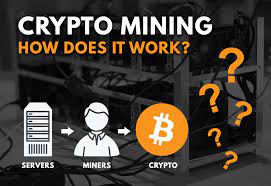
What Is Bitcoin Mining?
Bitcoin mining is the process by which new bitcoins are entered into circulation. It is also the way the network confirms new transactions and is a critical component of the blockchain ledger's maintenance and development. "Mining" is performed using sophisticated hardware that solves an extremely complex computational math problem. The first computer to find the solution to the problem receives the next block of bitcoins and the process begins again.
Cryptocurrency mining is painstaking, costly, and only sporadically rewarding. Nonetheless, mining has a magnetic appeal for many investors who are interested in cryptocurrency because of the fact that miners receive rewards for their work with crypto tokens. This may be because entrepreneurial types see mining as pennies from heaven, like California gold prospectors in 1849. And if you are technologically inclined, why not do it?
The bitcoin reward that miners receive is an incentive that motivates people to assist in the primary purpose of mining: to legitimize and monitor Bitcoin transactions, ensuring their validity. Because many users all over the world share these responsibilities, Bitcoin is a "decentralized" cryptocurrency or one that does not rely on any central authority like a central bank or government to oversee its regulation.
However, before you invest the time and equipment, read this explainer to see whether mining is really for you.
KEY TAKEAWAYS
- By mining, you can earn cryptocurrency without having to put down money for it.
- Bitcoin miners receive bitcoin as a reward for completing "blocks" of verified transactions, which are added to the blockchain.
- Mining rewards are paid to the miner who discovers a solution to a complex hashing puzzle first, and the probability that a participant will be the one to discover the solution is related to the portion of the network's total mining power.
- You need either a graphics processing unit (GPU) or an application-specific integrated circuit (ASIC) to set up a mining
Why Bitcoin Needs Miners
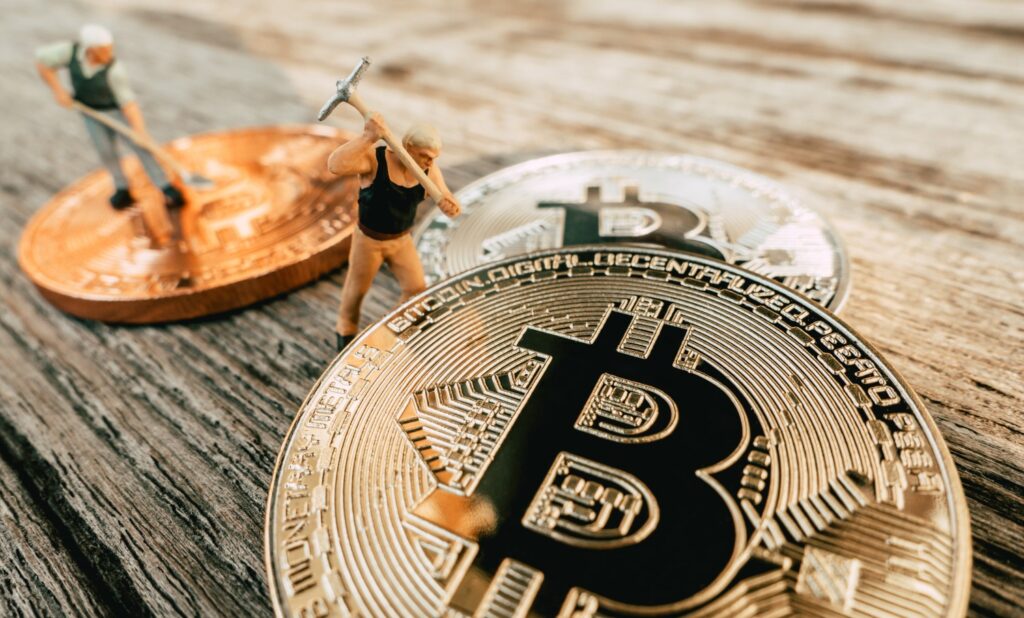
Blockchain "mining" is a metaphor for the computational work that nodes in the network undertake in hopes of earning new tokens. In reality, miners are essentially getting paid for their work as auditors. They are doing the work of verifying the legitimacy of Bitcoin transactions. This convention is meant to keep Bitcoin users honest and was conceived by Bitcoin's founder, Satoshi Nakamoto.
1 By verifying transactions, miners are helping to prevent the "double-spending problem."
Double spending is a scenario in which a Bitcoin owner illicitly spends the same bitcoin twice. With physical currency, this isn't an issue: When you hand someone a $20 bill to buy a bottle of vodka, you no longer have it, so there's no danger you could use that same $20 bill to buy lotto tickets next door. Though counterfeit cash is possible, it is not exactly the same as literally spending the same dollar twice. With digital currency, however, as the Investopedia dictionary explains, "there is a risk that the holder could make a copy of the digital token and send it to a merchant or another party while retaining the original."
Let's say you had one legitimate $20 bill and one counterfeit of that same $20. If you were to try to spend both the real bill and the fake one, someone who took the trouble of looking at both of the bills' serial numbers would see that they were the same number, and thus one of them had to be false. What a blockchain miner does is analogous to that—they check transactions to make sure that users have not illegitimately tried to spend the same bitcoin twice. This isn't a perfect analogy—we'll explain in more detail below.
Only 1 megabyte of transaction data can fit into a single bitcoin block. The 1MB limit was set by Satoshi Nakamoto, and this has become a matter of controversy because some miners believe the block size should increase to accommodate more data, which would effectively mean that the Bitcoin network could process and verify transactions more quickly.
How Much a Miner Earns
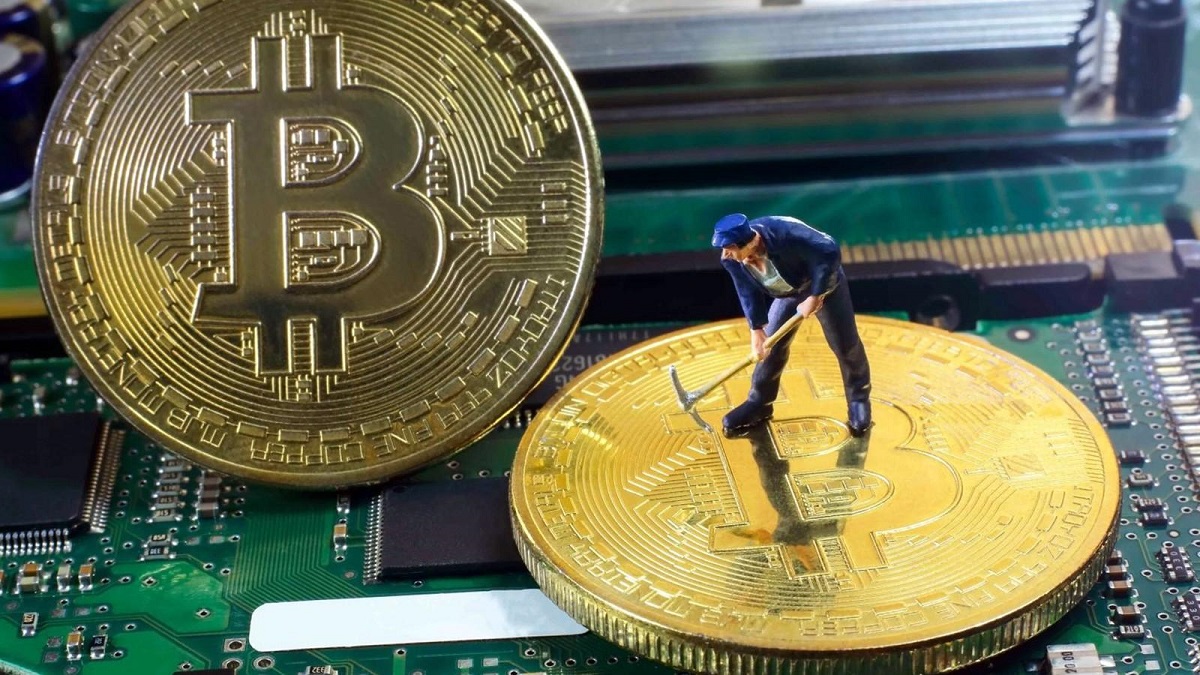
The rewards for Bitcoin mining are reduced by half roughly every four years.1 When bitcoin was first mined in 2009, mining one block would earn you 50 BTC. In 2012, this was halved to 25 BTC. By 2016, this was halved again to 12.5 BTC. On May 11, 2020, the reward halved again to 6.25 BTC.
As of February 2022, the price of Bitcoin was around $43,000 per bitcoin, which means you'd have earned $268,750 (6.25 x 43,000) for completing a block.4 Not a bad incentive to solve that complex hash problem detailed above, it might seem.
To keep track of precisely when these halvings will occur, you can consult the Bitcoin Clock, which updates this information in real-time. Interestingly, the market price of Bitcoin has, throughout its history, tended to correspond closely to the reduction of new coins entered into circulation. This lowering inflation rate increased scarcity and, historically, the price has risen with it.
What Are The Equipment You Need To Mine Bitcoin Units?
To acknowledge the equipment you need to mine bitcoin units, you should know about bitcoin mining. Bitcoin mining might be a great source of income and might employ thousands of people, but it is also a mandatory part of the bitcoin complex. Bitcoin mining performs two jobs in the bitcoin complex, foremost is maintaining the supply of bitcoin, and the second is increasing the bitcoin security.
Bitcoin mining performs the job of enhancing bitcoin supply by verifying every bitcoin transaction. Once an individual mines the bitcoin units, he can avail the block reward. Block reward of bitcoin mining contains several bitcoin units alongside the transaction fees. Miners can further sell this block reward using a trustable exchange.
Bitcoin mining is a computerized process. At the first instance of bitcoin release, the profitability of bitcoin mining was uncertain, so people used to mine bitcoin units with home computers only. However, this is no longer possible. The prominent reason behind this is that the difficulty and complexity of bitcoin mining are evolving at a tremendous pace and keep changing.
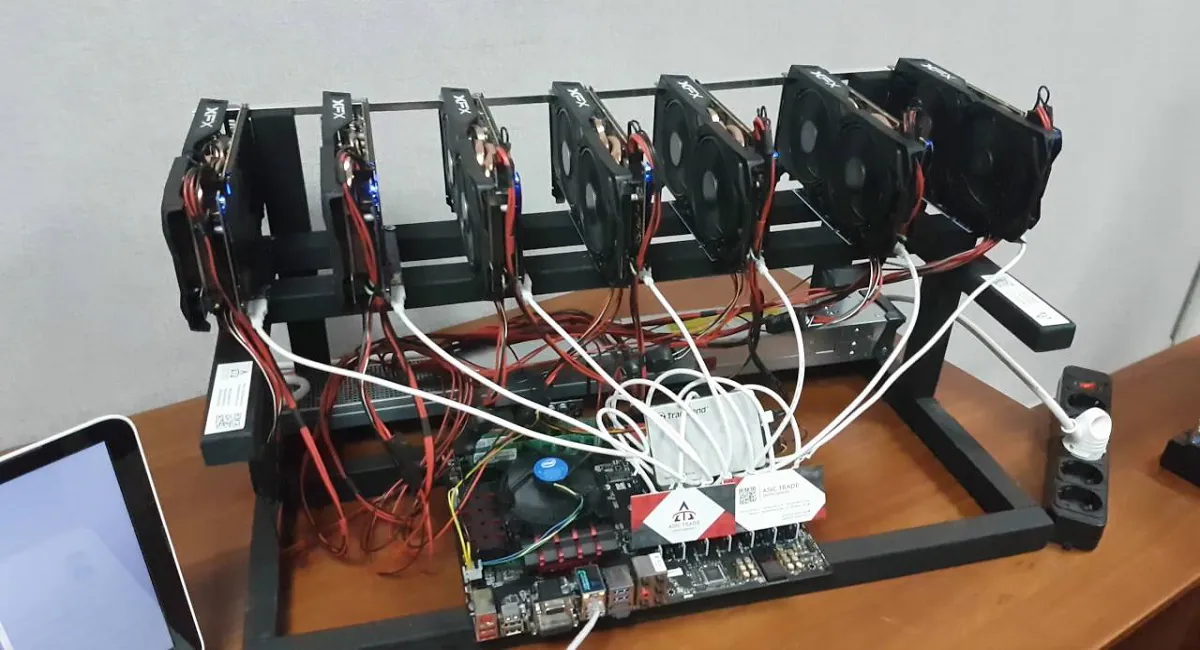
Bitcoin mining hardware
You are familiar with that blockchain, or the public distributed ledger contains blocks and information regarding bitcoin transactions. Bitcoin miners acquire 10 minutes to add new blocks to the blockchain.
All the more, bitcoin miners have to solve a math puzzle to verify these transactions. Bitcoin miners fight with each other miners to decode the math puzzle at the very first glance. To improve the chances of winning this math puzzle, bitcoin miners are now using bitcoin mining rigs. The bitcoin mining rigs are the potential of solving the block reward in a nominal range of time.


If you’re a Bitcoin (BTC) mining veteran, sulking over how zillion-dollar, ASIC-based data centers have stolen the spotlight, you’re probably already well into alternative coins. But maybe you’ve scored a cool-new GPU in the Newegg lottery or just happen to have one lying around. Or maybe you’re curious about whether all those hard drives you’ve got in your closet can earn you some cash via Chia. If you’re new to cryptocurrency mining, the good news is that the game isn’t completely over.
We’ll cover how you can get started mining (and in the case of Chia, farming) using hardware you may already have, or in theory can buy at retail, and provide our recent real-life experiences earning some hard cash from GPUs, CPUs, and drives. Note that this is definitely not a guide for devotees who are planning to build custom rigs for mining. It’s for those who are looking to see if they can generate some cash without too much effort, or are just curious about mining, using gear they might already own or can get off-the-shelf.
Mining Ethereum (ETH) Using Desktop GPUs
Assuming you have or can find a decent discrete GPU — or ideally, more than once — it’s incredibly easy to get started mining Ethereum. When I first wrote about mining BTC years ago, you needed to have a full node on the network, your own wallet, and probably establish yourself with a mining pool. Now, if you have an account at a cryptocurrency exchange that accepts ETH, like Coinbase, you can just use your wallet address from that account with mining pool software.
Unless you have a large number of GPUs to put to work, you’ll probably still want to join a mining pool. They’ll take a fee, but often that is only 1 percent. In exchange, you get a share of the proceeds from a large number of miners, rather than relying on your own probably meager chance of mining an entire coin on your own.
For my experiment, I joined Nanopool. Well, really there isn’t really any joining, per se. If you use its open-source Nanominer software, you simply give it your wallet address and launch it. There are versions for Windows and Linux, and it supports both AMD and Nvidia GPUs. I found that the CUDA version in particular enabled my RTX 3090 to produce hash rates of around 110Mh/s at full power and 100Mh/s after I throttled it back to keep the memory a little cooler.
My AMD GPUs weren’t competitive until I installed AMD’s custom crypto driver. However, if I was also using the same AMD GPU for gaming or applications, it’d be quite a hassle to switch drivers all the time. As another experiment, I tried mining on my laptop Quadro T2000 GPU. It never managed to get above 3Mh/s, so that was a not-unexpected dead end.

Here are some of the highest-performing GPUs for mining. Image by Tom’s Hardware.
If you’re up for a little more work, then mining applications like Claymore, Ethminer, and Phoenix miner give you more control and increased flexibility in choosing pools and coins to mine. ETHPool and Ethermine are two other, more established pool options. The coins you mine will determine how much GPU memory you need and tends to grow over time. Ideally, an 8GB or larger GPU will give you the most flexibility. One big change is that next year ETH is planning to move to a proof-of-stake method of mining to save energy. If that happens, GPU mining won’t work for Ethereum beyond that point, and you’ll need to switch currencies.
While the invention of ETH helped neutralize the power of multi-millionaire ASIC miners, it didn’t solve another major issue for cryptocurrency. Creating new coins typically required consuming energy. And the more effort that was put into mining, the more energy it took. At the limit, Bitcoin could consume most of the energy available worldwide, but it could also accelerate climate change, and perhaps hasten the end of life as we know it. Melodramatic, sure, but not impossible. ETH moved to compute back to regular GPUs, but it didn’t reduce the power requirement. While Ethereum’s 2022 move to proof of stake will address the issue, another approach has appeared in the meantime.

What Are Mining Pools?
The miner who discovers a solution to the puzzle first receives the mining rewards, and the probability that a participant will be the one to discover the solution is equal to the proportion of the total mining power on the network.
Participants with a small percentage of the mining power stand a very small chance of discovering the next block on their own. For instance, a mining card that one could purchase for a couple of thousand dollars would represent less than 0.001% of the network's mining power. With such a small chance at finding the next block, it could be a long time before that miner finds a block, and the difficulty going up makes things even worse. The miner may never recoup their investment. The answer to this problem is mining pools.
Mining pools are operated by third parties and coordinate groups of miners. By working together in a pool and sharing the payouts among all participants, miners can get a steady flow of bitcoin starting the day they activate their miners. Statistics on some of the mining pools can be seen on Blockchain.info.
A Pickaxe Strategy for Bitcoin Mining
As mentioned above, the easiest way to acquire Bitcoin is to simply buy it on one of the many Bitcoin exchanges. Alternately, you can always leverage the "pickaxe strategy." This is based on the old saw that during the 1849 California Gold Rush, the smart investment was not to pan for gold, but rather to make the pickaxes used for mining.
To put it in modern terms, invest in the companies that manufacture those pickaxes. In a cryptocurrency context, the pickaxe equivalent would be a company that manufactures equipment used for Bitcoin mining. You may consider looking into companies that make ASIC equipment or GPUs instead, for example.
Downsides
The risks of mining are often financial and regulatory. As aforementioned, Bitcoin mining, and mining in general, is a financial risk because one could go through all the effort of purchasing hundreds or thousands of dollars worth of mining equipment only to have no return on their investment. That said, this risk can be mitigated by joining mining pools. If you are considering mining and live in an area where it is prohibited, you should reconsider. It may also be a good idea to research your country's regulation and overall sentiment toward cryptocurrency before investing in mining equipment.
One additional potential risk from the growth of Bitcoin mining (and other PoW systems as well) is the increasing energy usage required by the computer systems running the mining algorithms. Though microchip efficiency has increased dramatically for ASIC chips, the growth of the network itself is outpacing technological progress. As a result, there are concerns about Bitcoin mining's environmental impact and carbon footprint.7
There are, however, efforts to mitigate this negative externality by seeking cleaner and green energy sources for mining operations (such as geothermal or solar sources), as well as utilizing carbon offset credits. Switching to less energy-intensive consensus mechanisms like proof-of-stake (PoS), which Ethereum has transitioned to, is another strategy; however, PoS comes with its own set of drawbacks and inefficiencies, such as incentivizing hoarding instead of using coins and an RK of centralization of consensus control.
Mining is a metaphor for introducing new bitcoins into the system because it requires (computational) work just as mining for gold or silver requires (physical) effort. Of course, the tokens that miners find are virtual and exist only within the digital ledger of the Bitcoin blockchain.
Why Do Bitcoins Need to Be Mined?
Because they are entirely digital records, there is a risk of copying, counterfeiting, or double-spending the same coin more than once. Mining solves these problems by making it extremely expensive and resource-intensive to try to do one of these things or otherwise "hack" the network. Indeed, it is far more cost-effective to join the network as a miner than to try to undermine it.
How Do Mining Confirm Transactions?
In addition to introducing new BTC into circulation, mining serves the crucial role of confirming and validating new transactions on the Bitcoin blockchain. This is important because there is no central authority such as a bank, court, government, or anything else determining which transactions are valid and which are not. Instead, the mining process achieves a decentralized consensus through proof of work (PoW).
Why Does Mining Use So Much Electricity?
In the early days of Bitcoin, anybody could simply run a mining program from their PC or laptop. But as the network got larger and more people became interested in mining, the mining algorithm became more difficult. This is because the code for Bitcoin targets finding a new block once every 10 minutes, on average.1 If more miners are involved, the chances that somebody will solve the right hash quicker increases, and so the difficulty increases to restore that 10-minute goal. Now imagine if thousands, or even millions more times that mining power joins the network. That's a lot of new machines consuming energy.
Is Bitcoin Mining Legal?
The legality of Bitcoin mining depends entirely on your geographic location. The concept of Bitcoin can threaten the dominance of fiat currencies and government control over the financial markets. For this reason, Bitcoin is completely illegal in certain places.
Bitcoin ownership and mining are legal in more countries than not. Some examples of places where it was illegal according to a 2018 report were Algeria, Egypt, Morocco, Bolivia, Ecuador, Nepal, and Pakistan.8 Since 2018, other countries have banned Bitcoin mining including Bangladesh, China, Dominican Republic, North Macedonia, Qatar, and Vietnam.9101112 Overall, Bitcoin use and mining remain legal across much of the globe.
Does Crypto Mining Damage Your GPU/Computer?
Because blockchain mining is very resource-intensive, it can put a large strain on your GPU or other mining hardware. In fact, it is not unheard of for GPUs to blow out, or for mining rigs to burst into flames.13 However, keeping your rigs running at a moderate pace and with a sufficient power supply is generally safe.
Can You Mine Bitcoin on Your iPhone?
No. Bitcoin mining today requires vast amounts of computing power and electricity to be competitive. Running a miner on a mobile device, even if it is part of a mining pool, will likely result in no earnings.


0 Comments